
The Direct Booking Playbook
Stop Relying on OTAs
Stop losing 20% of your revenue. This guide shows you exactly how to increase direct bookings and stop relying solely on OTAs.
If you run a boutique hotel, a B&B, or a guesthouse, you know the feeling all too well.
You receive a booking notification. You smile because you have a guest. And then you frown because you remember the math:15% to 20% of that booking revenue isn’t yours. It belongs to Booking.com, Airbnb, or Expedia
OTAs (Online Travel Agencies) are a necessary evil. They bring you visibility that you cannot get on your own. But relying on them for all your bookings is a dangerous business model.
You don’t own the guest data, you don’t control the relationship, and you are renting your own customers.
Are you losing €5,000 or €50,000?
You define your room rates, but OTAs define your profit. I built a simple calculator to show you exactly how much revenue you are “donating” to Booking.com every year.
Why Guests Visit Your Site (But Don’t Book)
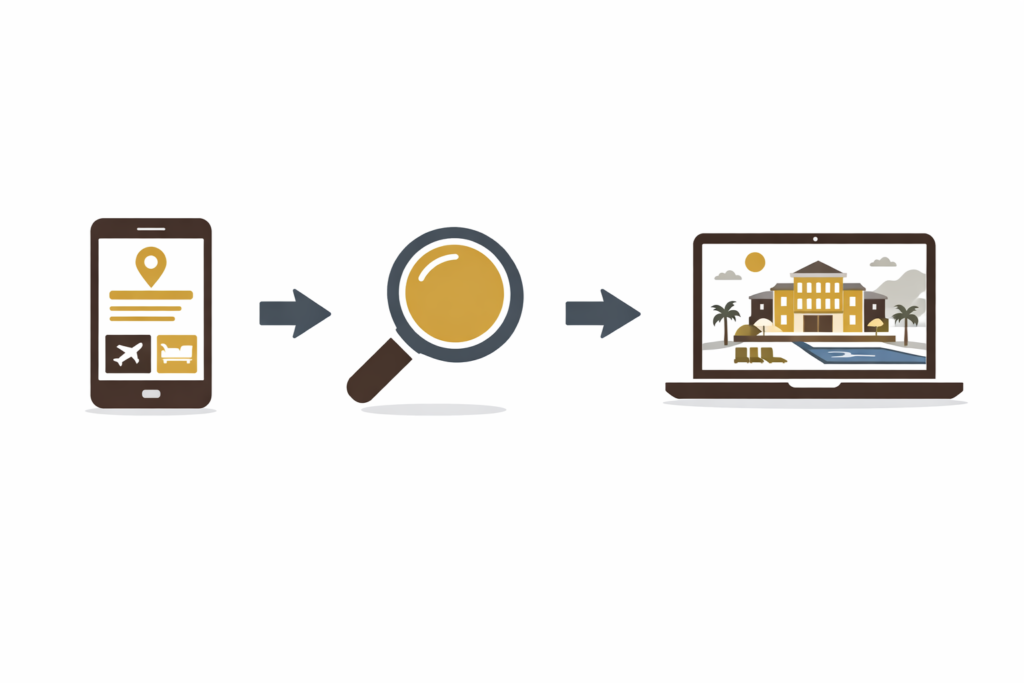
Here is a statistic that OTAs don’t want you to know: Over 52% of travelers will visit your hotel’s official website after finding you on an OTA.
This is called the Billboard Effect. Travelers use Booking.com as a search engine to find options, but they often prefer to book directly with the property. Why?
So, why do they leave your site and go back to the OTA to pay? Usually, it is because your website failed one of three tests.
The good news? You don’t need a million-dollar marketing budget to fight back. You just need to fix the “leaky bucket” that is your current website.
Test 1: Speed is the New Luxury
Travelers are impatient. In 2025, they are often booking on their phones while in a taxi, at an airport, or using a slow data connection while walking through the city.
If your website takes more than 3 seconds to load, you have lost them.
Google’s data shows that as page load time goes from 1 second to 3 seconds, the probability of a user leaving (bouncing) increases by 32%.
If your site is heavy, slow, or clunky, the user will simply hit the “Back” button and book on the OTA app, which they know is fast and easy.
The Fix
You don’t need a heavy website with fancy animations that slow everything down. You need a professional Direct Booking Website with high-performance architecture.
Test 2: The “Trust” Signal
When a guest lands on your site, they are asking one subconscious question: “Is this place real, safe, and professional?”
An outdated website—with a copyright date of 2018 in the footer, a blurry logo, or broken links—screams “risk.” It makes the guest worry that the hotel itself might be dirty or poorly managed.
A clean, modern, and structured website screams “Professionalism.”
The Fix
Your website needs to look better than your Booking.com listing.
Test 3: The Booking Experience
This is where most small hotels fail. They hide their “Book Now” button. Or, worse, they use a booking engine that opens a weird, ugly pop-up window that looks like a spreadsheet from 1999. If it is harder to book on your site than on Booking.com, the guest will go back to Booking.com.
The Fix
Make the booking process smoother than the OTA app!
The Bottom Line: How to Increase Direct Bookings Today
You will never beat Booking.com at marketing traffic. They spend billions on Google Ads. But you can beat them at conversion.
When a guest lands on your site, that is your customer to lose.
By building a website that is fast, builds trust, and makes booking effortless, you will significantly increase direct bookings and keep 100% of the revenue.
Is Your Website Leaking Money?
Not sure if your current website is fast enough or trustworthy enough to capture these direct bookings?
Enter your website URL below, and I will send you a Free, Personalized Video Audit